It Took a Special Kind of Person to Come Up With It (4/8): Claude Grison, Environmental Researcher

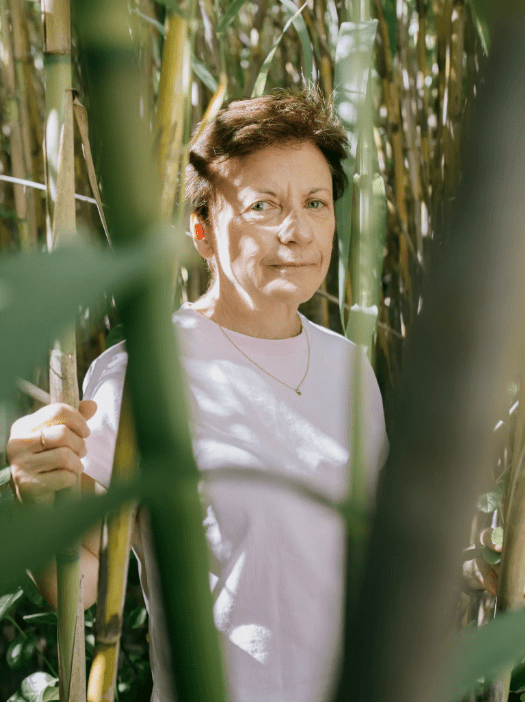
Portrait.
The chemist uses plants to purify water or to make medicines.
Biodiversity Feature: Whether they’re behind a scientific or ecological breakthrough, a whimsical discovery, or an unexpected practical tip, *Libé* went out to meet inventors from all walks of life
Libération
August 5, 2026, by Olivier Monod
Link to the full article
Excerpts:
Claude Grison walks quickly. Petite, with short hair and blue eyes, the researcher makes us pick up the pace to keep up with her as she winds her way through her laboratory on the outskirts of Montpellier (Hérault). The trail running enthusiast also prefers to take the stairs to climb the three floors.“She’s hyperactive,” warnsClaire Grison, her only daughter, who is also a member of the team. Claude, the mother, has put her hyperactivity to good use. At 65, she heads the laboratory for bio-inspired chemistry and ecological innovations, has launched four startups, and has received a slew of awards, including the CNRS Medal for Innovation, the Legion of Honor, and the European Inventor Award. Few researchers can boast such an impressive track record.“I consider it my duty to seek solutions, some of which sometimes lead to innovations,” commentsthe mother of eco-catalysis matter-of-factly.
Behind this neologism lies an elegant approach. Everything revolves around plants—especially the less noble ones: weeds, invasive species, and poisonous plants. Claude Grison studies them for their ability to extract heavy metals, such as zinc or palladium, from the soil. She sees two revolutionary applications for them. In the field, they are allies in the fight against soil and water pollution. In the lab, ground into powder, they facilitate industrial chemical reactions—what are known as “catalysts” in the jargon. In this case, they are eco-catalysts, since they come neither from polluting mines nor from the oil industry. And here is Claude Grison, a pioneer in green chemistry.
“Her great achievement is having reconciled two disciplines—chemistry and ecology—that didn’t get along very well,”comments Jacques Bessière, one of her first chemistry professors at the University of Nancy. From one, she gained an ecological consciousness; from the other, a desire to work with everyone. So when the mining giant Eramet contacted her to examine its abandoned sites in New Caledonia, she considered the proposal without hesitation:“I met some fascinating people who were genuinely interested in their work.” Claude Grison studies the plants growing near the site and identifies those best suited to restoring the soil. As a result, for the past ten years, she has been removing 2% of the heavy metals present in the area each year, allowing local flora to return. “This isn’t decontamination in the strict sense of the term, but ecological restoration,”she explains. She doesn’t stop there. Every year, she collects fallen leaves, shreds them, and repurposes them as eco-catalysts. A seemingly simple action, but one that has taken her years of work.
Far from being narrow-minded, Claude Grison spent a long time figuring out who she was.“I loved all subjects, except maybe history.”For this daughter of two employees at the Banque Postale in Verdun, history“is just horrible stories about war.” Her grandfather, also an employee at the Banque Postale, fought in the trenches from 1914 to 1918. During World War II, his home was occupied. He also had to travel to Germany to retrieve one of his sons, who had been deported for his political views. So, when her grandchildren invited a German tourist they were showing around the city, the grandfather initially refused to let him cross the threshold.“He didn’t want a German to come into his home. Our guest understood the situation, started playing the violin, and was then allowed in,”she recalls.
Claude Grison adapts as her interactions unfold. She is thus able to maintain a connection with a child who gave her a presentation at a science fair, says Valérie Cibot, who has made two documentaries about her work. She describes the researcher as a blend of“concentration,” “tact,” “sharpness,” and“curiosity.” She ultimately chose chemistry thanks to some“wonderful”teachers.One of them even became her husband, who passed away two years ago.“It’s very hard to find yourself alone,”she admits. An event that inevitably makes one think about one’s own passing.“You prepare for it—not for yourself, but for those left behind.”
As her retirement approaches—in August 2027—the researcher hopes to establish a team that will carry on her work. With her daughter on the team, it’s only fitting, since Claire Grison played a pivotal role in the development of the groundbreaking idea upon which her mother built her career.
…
In her work, this appetite for risk also translates into an ability to launch companies to bring her research to life. Here again, despite some misunderstandings.“When I founded my first startup, flyers were handed out in the cafeteria claiming that I was bringing big business into the lab,”she laments. That shows a lack of understanding of the ethics of this woman who has been a vegetarian for twenty years.“When it became clear that the investor was much more interested in the chemical aspect than in ecological restoration, I ended the partnership, and the CNRS supported my decision,” she explains. That didn’t stop her from developing other projects. One project uses powder made from invasive plants to purify water; the other, more surprisingly, is a mosquito repellent.“I realized that one of my eco-catalysts could facilitate the reaction involved in making a mosquito repellent and increase its effectiveness,”explains Claude Grison. True to form, she saw the project through to the end,bringing a“100% plant-based”product to market—though it isn’t sold in big-box stores:“That’s not in line with our values.”
…
August 10, 1960: Born in Verdun-sur-Meuse.
1990: His daughter was born.
2022European Female Inventor of the Year Award.